

Court of Appeals
The District of Columbia Court of Appeals is the highest court of the District of Columbia. It was created in 1970 when Congress passed a law called the District of Columbia Court Reform and Criminal Procedure Act. The court consists of a chief judge, eight associate judges, and a varying number of retired judges who continue to serve as senior judges.
Opinions & MOJs
The court generally explains its decisions in one of two types of opinions:
- Published Opinions: These types of opinions are binding precedent. This means other courts must follow them. You can use these opinions to support legal arguments in your case. They are available in official legal reporters and on the court’s website.
- Memorandum Opinion and Judgments (MOJs): These types of opinions are not binding precedent and cannot be used to support legal arguments in other cases. The court only lists MOJs by case name and number without the full text provided.
Oral Arguments
Sometimes, the court asks parties to appear before a group of judges and answer questions about their case. This is called "oral argument." The court live streams these arguments and also saves recordings of them.
Other times, the court makes decisions by reading written arguments called "briefs” and reviewing the filings, transcripts, and exhibits from the trial.
You can look up publicly available case information online. Keep in mind that access to certain case details may be restricted due to privacy considerations or court rules.
The court’s calendars show when cases are being argued before the court (the regular calendar) and when cases are being submitted to the court for decision on the briefs without oral argument (the summary calendar).
The court allows parties to file court documents online. This is called "e-filing." It helps make legal filings faster, more organized, and easier to access. Lawyers must use e-filing, but people without a lawyer can choose to use it if they want to.
Overview
Jurisdiction
The District of Columbia Court of Appeals is the highest court for the District of Columbia. It reviews final decisions and certain temporary ones made by the Superior Court of the District of Columbia. The court also reviews decisions of administrative agencies, boards, and commissions of the District of Columbia government.
The court decides questions of law certified by federal and state appellate courts. It also oversees the District of Columbia Bar and is the final decisionmaker in attorney discipline cases and cases concerning the unauthorized practice of law in the District of Columbia.
The court’s decisions are reviewable only by the Supreme Court of the United States.
How Appeals Are Decided
Appeals before the court are generally decided by three-judge panels or divisions of the court. In some cases, the en banc court, generally consisting of all the active judges, will rehear a case after the division has issued a decision; this is called rehearing en banc. And rarely, the en banc court, instead of a division, will hear an appeal in the first instance. The court only grants en banc review when consideration by the full court is necessary to maintain the uniformity of its decisions or when the case involves a question of exceptional importance.
The Court's Rules
The court issues its own rules modeled on the Federal Rules of Appellate Procedure. The court also reviews proposed rule changes of the Superior Court.
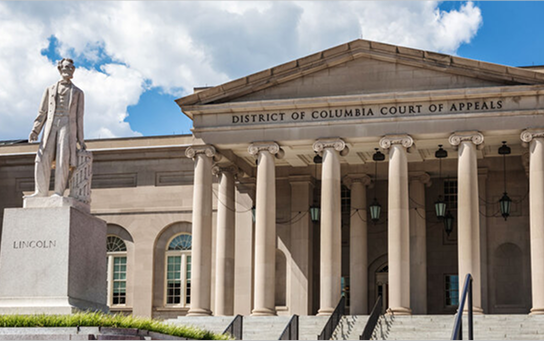
The Historic Courthouse
Originally designed in 1820 to serve as the first City Hall, the Historic DC Courthouse is a National Historic Landmark and one of the oldest public buildings in the District of Columbia. By the early 2000’s, the building had been subject to numerous changes and additions and was in critical need of a comprehensive overhaul.
In 2002, the Court of Appeals undertook efforts to restore and expand the building with the goal of returning the architectural landmark to its previous grandeur, while at the same time transforming it into a state-of-the-art modern courthouse. The Court of Appeals moved into the newly renovated building in 2009.
Judges and Clerkships
Rules, Guidelines, IOPs and Ethics
Attorney Information
The Clerk's Office receives all filings and maintains the dockets and files pertaining to all cases filed in the Court of Appeals, including attorney discipline matters.
Administrative Notices and Orders relate to the administration of the court and its various committees.
Information about when you can appeal, how to start an appeal, important deadlines, and costs and fee waivers can be found here.
The court has resources, guides and tools for understanding the legal process and finding a lawyer.
The Court of Appeals Appellate Mediation Program is an informal, confidential process in which the parties work with an impartial mediator, trained and selected by the court, to assist them in reaching a negotiated resolution of their case.
The CUPL hears complaints about people practicing law in the District without authorization and issues opinions about Court of Appeals Rule 49, which governs the unauthorized practice of law.